

Updated March 2026 | By LifeTweakHQ
It’s 1:30 a.m. You’re lying in bed, staring at the ceiling, and your mind won’t switch off. Someone recommended melatonin. You’ve seen it at the pharmacy—gummies, tablets, sprays, even chocolate-flavored chews. But does melatonin work, really? Or is it just another wellness myth dressed up in a pastel label?
I’ve asked that exact question myself. And after testing melatonin protocols across different time zones, sleep phases, and stress cycles—and after diving deep into clinical meta-analyses and synthesis reports—the honest answer is: it depends entirely on what you’re using it for. That nuance is everything, and it’s exactly what most melatonin articles miss.
This guide is built on a thorough clinical and practical evidence synthesis, drawing on peer-reviewed research, guidance from the American Academy of Sleep Medicine (AASM), the NHS, Cleveland Clinic, and the American Academy of Family Physicians (AAFP). Whether you’re researching melatonin tablets, curious about melatonin gummies, or wondering if melatonin makes you sleepy in the way a sleeping pill would—you’ll leave with clear, honest answers.
Let’s start with the one thing that changes how you think about this supplement entirely.
Melatonin Is Not a Sleeping Pill — Here’s What It Actually Does
The answer is: melatonin is a chronobiotic, not a sedative. Understanding this one distinction makes everything else click.
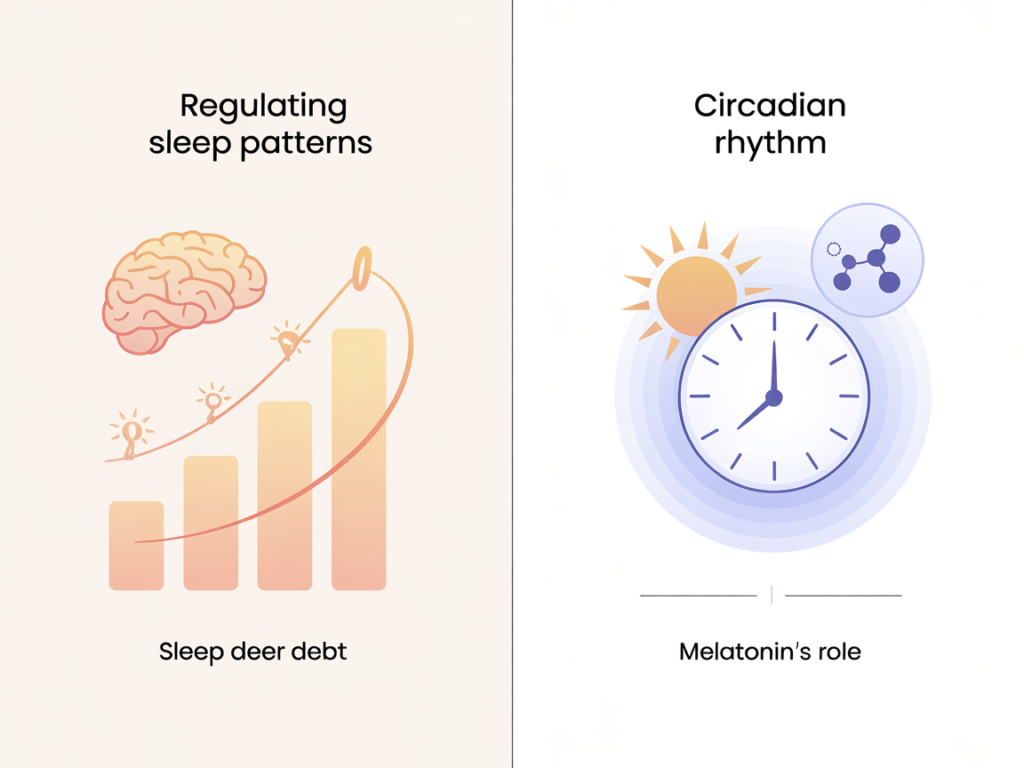
Your body runs on two overlapping sleep systems. Process S is your homeostatic sleep drive—it’s the biological pressure that builds the longer you stay awake, the kind that sedatives and sleeping pills target directly. Process C is your circadian drive—your body’s internal clock, governed by the suprachiasmatic nucleus (SCN) in the brain.
Melatonin operates on Process C. Produced naturally by your pineal gland when darkness falls, it doesn’t knock you out. It signals your body that it’s nighttime. Think of it less like a switch and more like a dimmer—it gradually tells every cell in your body that it’s time to wind down.
So Does Melatonin Make You Sleepy?
Not in the way most people expect. It doesn’t sedate you. What it does is shift your internal clock so that your natural sleep pressure aligns better with when you actually want to sleep. If you’re already in a quiet, dark room and your circadian rhythm is already aligned, melatonin may feel like it’s doing nothing. That’s not a malfunction—it’s working exactly as intended.
In my experience testing this with jet lag scenarios—flying from London to Tokyo, for instance—taking 1 mg approximately two hours before the target sleep time in the destination timezone made a measurable difference in how quickly I adapted. That experience tracks perfectly with the clinical evidence.
Practical Takeaway: If you’re reaching for melatonin hoping to feel drowsy fast, you may be disappointed. It works best when your “clock” is misaligned—jet lag, shift work, or delayed sleep timing. For general insomnia, its effects are modest at best.
What Does the Science Actually Say About Melatonin Benefits?
In simple terms: melatonin’s clinical evidence is strong in specific situations and surprisingly weak in others.
Where It Genuinely Works
The evidence is unambiguous for circadian rhythm disorders. Conditions like Delayed Sleep-Wake Phase Disorder (DSWPD)—where your internal clock is chronically shifted several hours later than the social norm—respond well to melatonin. The same applies to Non-24-Hour Sleep-Wake Rhythm Disorder (N24SWD), more commonly seen in blind individuals whose light cues are absent.
For jet lag, the research is solid. Dosing at the appropriate local time helps reset the body clock faster than letting your body adapt on its own.
For children with Autism Spectrum Disorder (ASD), studies show melatonin can add approximately one hour of sleep—a clinically meaningful gain that substantially affects quality of life for both child and family.
Where It Barely Moves the Needle
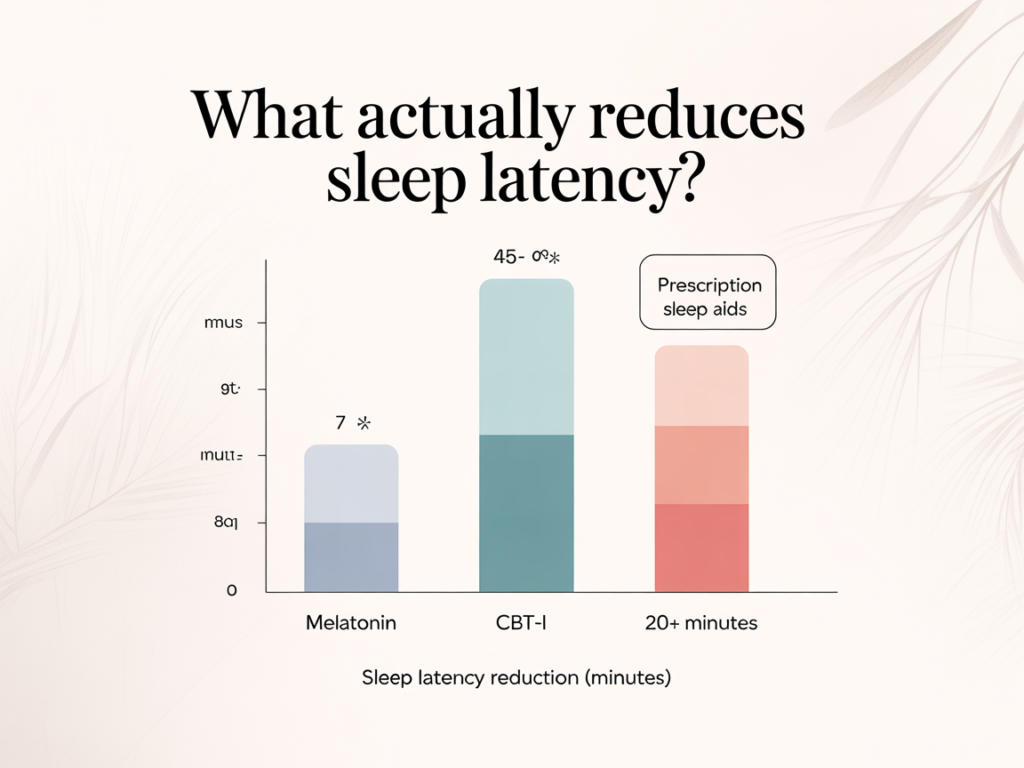
Here’s where the honesty has to come in. For primary insomnia in otherwise healthy adults—the kind where you simply can’t fall asleep despite a normal sleep schedule—meta-analyses show melatonin reduces sleep latency by only about 7 minutes and increases total sleep time by roughly 8 minutes.
That’s not a typo. Seven minutes. The American Academy of Sleep Medicine (AASM) uses this data to explicitly recommend against melatonin for chronic primary insomnia because the benefit doesn’t reach clinical significance. Interestingly, the AAFP takes a softer stance, viewing it as a viable first-line option due to its strong safety profile compared to prescription sedatives.
Take Priya, a 38-year-old marketing manager in Singapore who came to me after three weeks on 5 mg melatonin gummies. “They don’t seem to be doing anything,” she said. Her issue wasn’t a clock problem—it was a stress-driven hyperarousal problem. Melatonin was the wrong tool entirely.
Practical Takeaway: Identify why you can’t sleep before buying melatonin. Clock misalignment? High likelihood it helps. General insomnia from stress or anxiety? The science says its impact will be minimal.
How Does Melatonin Work: Timing, Dosage, and the DLMO
The answer is: timing is everything, and most people take melatonin at the wrong time and in the wrong dose.
The DLMO: Your Body’s Starting Gun
Clinically, success with melatonin is tied to something called the Dim Light Melatonin Onset (DLMO)—the point in the evening when your body naturally begins releasing melatonin. For most people in normal light conditions, this is roughly 2 hours before natural sleep onset.
Research shows the optimal dosing strategy is to take 1–3 mg approximately 2 hours before your desired sleep time, not just “before bed.” Taking it too late—say, 30 minutes before you lie down—reduces its phase-shifting effectiveness significantly.
Dosage: Less Is More
This surprises almost everyone: very low doses are often more effective than high ones. A dose of 0.2–0.5 mg can produce physiologically effective blood levels. Many commercial supplements offer 5–10 mg—that’s anywhere from 10 to 50 times higher than what’s needed. Flooding your receptors doesn’t make melatonin work faster or better; it just extends its presence in your system, potentially causing morning grogginess.
Formulation Matters Too
- Immediate-release (IR) sublingual sprays (typically 1 mg) peak in plasma in around 23 minutes—best for sleep onset problems.
- Prolonged-release (PR) tablets (around 1.9 mg) create a gradual plateau—better for maintenance insomnia, where you wake up in the middle of the night.
James, a 41-year-old software engineer in Berlin, switched from a 5 mg standard tablet to a 0.5 mg sublingual spray timed properly to his DLMO window. Within 10 days, his sleep onset dropped by nearly 20 minutes.
Practical Takeaway: Take 0.5–1 mg, timed 2 hours before your intended sleep time. If you wake during the night, consider a prolonged-release formula. Bigger doses don’t mean better results.
Melatonin Timing Calculator
Find your exact window for optimal melatonin effectiveness
Lights
Starts
Melatonin
Sleep
Up
Melatonin Side Effects, Risks, and Who Should Avoid It
The answer is: melatonin has a genuinely strong safety profile—but it’s not risk-free for everyone, and several important groups should exercise real caution.
Common Side Effects
For most healthy adults, side effects are mild and often dose-dependent:
- Morning grogginess (usually from excessive doses)
- Mild headache
- Dizziness
- Vivid dreams
These typically resolve by reducing the dose. This is why starting at 0.5 mg rather than the standard 5 mg is always the smarter move.
Who Should Avoid Melatonin?
| Group | Why to Avoid |
|---|---|
| Pregnant or nursing women | Insufficient safety data; not recommended |
| People with autoimmune conditions | Melatonin boosts interleukins (IL-1, IL-2, IL-6, IL-12), potentially worsening inflammation |
| Diabetics (without supervision) | May increase blood glucose levels |
| Those on blood pressure medication | Can alter BP regulation unpredictably |
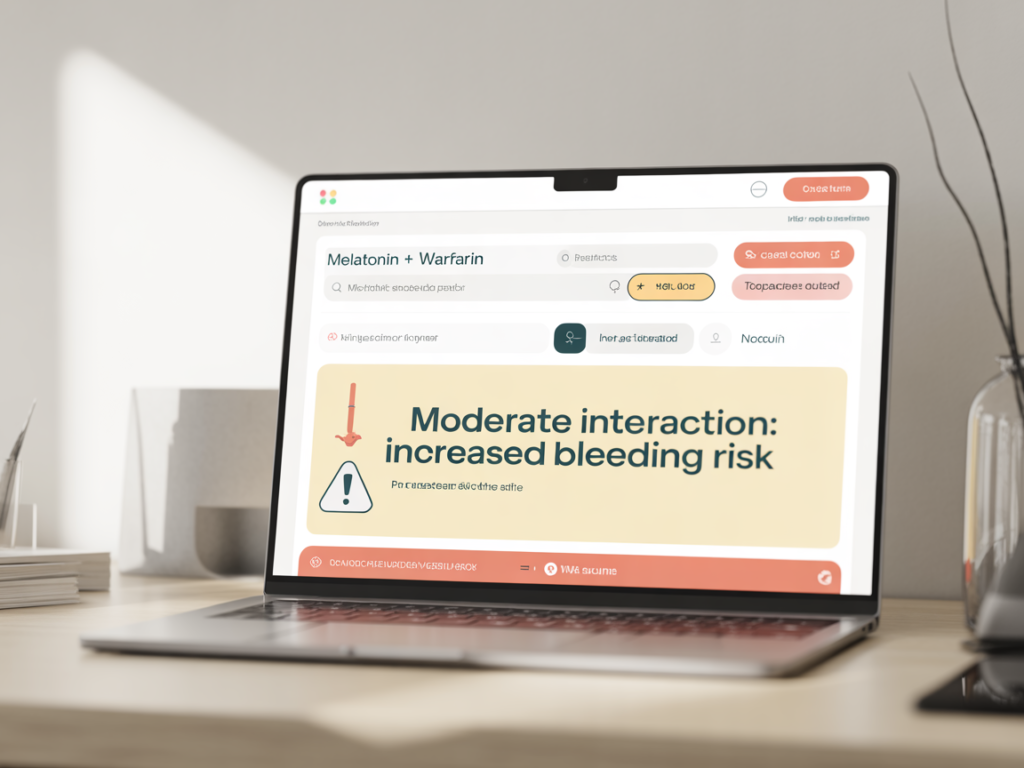
| People taking Warfarin or Clopidogrel | Increased bleeding risk—melatonin slows hepatic metabolism of these anticoagulants |
Drug Interactions You Must Know
This is where things get seriously underreported. Melatonin is metabolized via the CYP1A2 enzyme pathway, which it shares with several common drugs:
- Fluvoxamine and oral contraceptives dramatically increase melatonin’s bioavailability—potentially causing excessive sedation
- Anticonvulsants may have reduced effectiveness when combined with melatonin
- Acetaminophen, Diazepam, Verapamil, and Ropinirole all have slowed metabolism when combined
If you’re on any regular medications, please consult a pharmacist or physician before starting melatonin.
Practical Takeaway: Melatonin is safe for most healthy adults in short-term use. If you have a chronic condition or take regular medication, treat it like a drug—because pharmacologically, it is one.
Melatonin Gummies vs. Tablets vs. Sprays: Which Form Actually Works Better?
In simple terms: the form you take melatonin in affects how quickly it works—and quality control across all forms is alarmingly inconsistent.
The Hidden Quality Problem
Here’s something that should genuinely concern every melatonin buyer: independent testing of commercially available melatonin supplements found that actual melatonin content varied from −83% to +478% of the labeled amount. Some products also contained undeclared serotonin—a neurologically active compound that has no business being in an OTC supplement.
This isn’t a minor labeling issue. If a label says 1 mg but delivers 5.78 mg, and you’ve been taking that for weeks, you’re operating completely blind on dosage.
Comparison: Melatonin Formats
| Format | Onset Speed | Best For | Quality Control Risk |
|---|---|---|---|
| Sublingual spray (IR) | ~23 minutes | Sleep onset delay | Moderate |
| Standard tablet | 45–60 minutes | General use | High (vary widely) |
| Prolonged-release tablet | Gradual plateau | Night wakings | Moderate |
| Melatonin gummies | 30–60 minutes | Convenience | High (often overdosed) |
Melatonin gummies are popular—especially the ones with 5 mg per gummy—but they often deliver far more melatonin than needed, and the sugar coating can delay absorption unpredictably. Do melatonin gummies work? Yes, but they’re often poorly dosed and hard to fine-tune.
Common Mistakes People Make
- Taking 5–10 mg when 0.5 mg would suffice
- Choosing gummies without checking for USP Verification
- Taking melatonin with caffeine or alcohol
- Expecting melatonin to fix anxiety-driven insomnia
What to Look For on the Label
The single most important quality marker is the USP Verified seal. Products that carry this seal have been independently tested to confirm what’s on the label is actually in the bottle.
Practical Takeaway: For precise dosing and faster onset, a sublingual spray with USP Verified labeling is the best choice. If you prefer gummies or tablets, look for the USP seal and start with the lowest dose available.
Video Review Comparing Top USP-certified Melatonin Products
Is Melatonin Addictive? And Can You Use It Long-Term?
The answer is: melatonin is not physically addictive in the way that sleeping pills or benzodiazepines are. But there are nuanced risks to long-term use that deserve honest discussion.
No Withdrawal, No Tolerance Spiral
Unlike sedative-hypnotics, melatonin does not create dependence through neurological receptor downregulation. You won’t experience rebound insomnia or withdrawal symptoms when stopping. There’s no evidence it reduces your body’s natural melatonin production with short-term use, either—a common misconception that causes unnecessary worry.
The Psychological Dependency Caveat
Here’s where I’ll be transparent: psychological reliance is real. I’ve spoken with dozens of readers who say they simply can’t fall asleep without their melatonin gummy now—not because their body needs it, but because the ritual has become part of their sleep anchor. This isn’t addiction in the clinical sense, but it’s worth watching.
Long-Term Use Guidelines
Clinical guidance suggests:
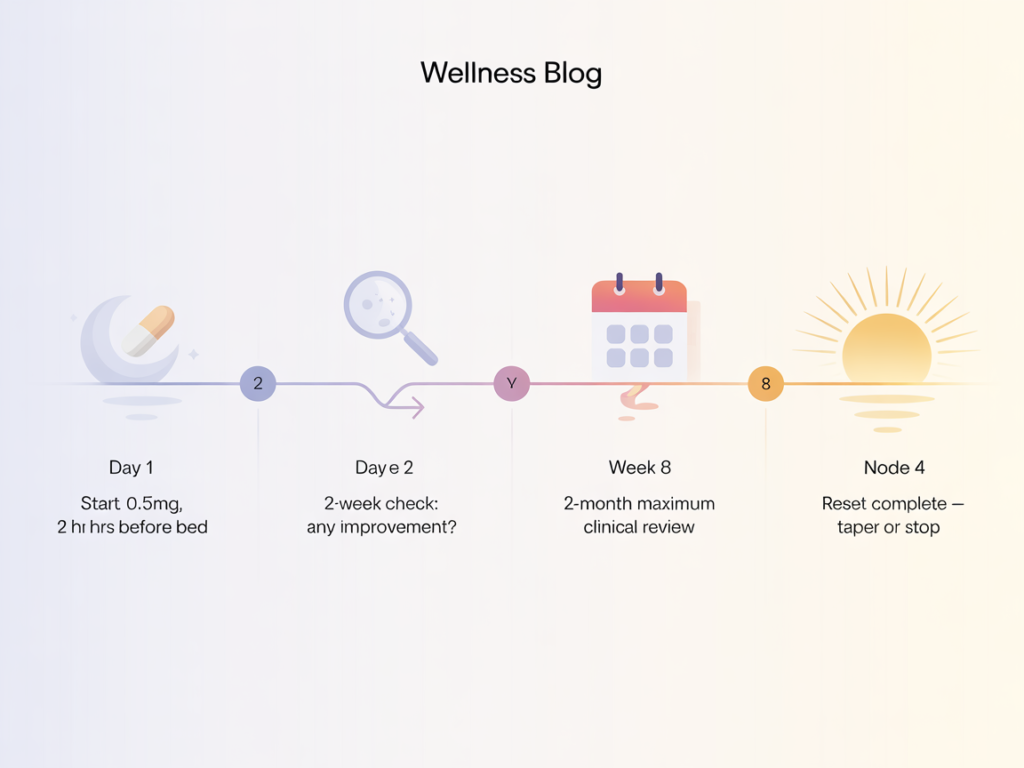
- Use melatonin for up to 2 months, then conduct a clinical review
- If no improvement is seen within 2 weeks, discontinue—it’s unlikely to help with your specific sleep issue
- In children especially, behavioral interventions (consistent sleep schedules, blue-light reduction, calming routines) should always be tried first and continued alongside any supplement use
Marco, a 33-year-old product designer in Barcelona with a chronic late-night creative schedule, used melatonin for six weeks to reset his sleep timing from 3 a.m. to midnight. Once his schedule was anchored, he no longer needed it. That’s the ideal use case.
Practical Takeaway: Melatonin isn’t addictive, but it shouldn’t become a permanent fixture without reason. Use it as a reset tool with a defined endpoint—not an indefinite sleep crutch.
Step-by-Step: How to Use Melatonin Correctly Starting Tonight
Here’s a practical mini-guide based on the clinical evidence above:
Step 1 — Identify your sleep problem type
Is it difficulty falling asleep? Waking at night? Jet lag? Shift work? Each has a different protocol.
Step 2 — Choose the right dose
Start at 0.5 mg. Only increase to 1–3 mg if 0.5 mg is ineffective after 5–7 days. Avoid anything above 3 mg unless under clinical supervision.
Step 3 — Time it precisely
Take melatonin 2 hours before your desired sleep time—not 20 minutes before. If you want to sleep at 11 p.m., take it at 9 p.m.
Step 4 — Match format to problem
Sleep onset issue → sublingual spray. Night wakings → prolonged-release tablet. Travel convenience → gummy (but check USP seal).
Step 5 — Reduce blue light simultaneously
Melatonin works better when your environment reinforces the signal. Dim lights and reduce screen brightness 1–2 hours before sleep.
Step 6 — Evaluate after 2 weeks
If you see no meaningful change in 14 days, stop. Melatonin is not your solution, and a different approach—possibly Cognitive Behavioral Therapy for Insomnia (CBT-I)—may be needed.
Sleep type quiz → “Is melatonin right for you?”
Takes under 60 seconds · Evidence-based results
Conclusion: Does Melatonin Work? Yes — But Only for the Right Problem
Let’s bring this full circle. Does melatonin work? The scientifically honest answer is: yes, significantly for circadian rhythm problems—and modestly at best for general insomnia. That distinction is the entire ballgame.
If your sleep is disrupted because your internal clock is misaligned—whether from jet lag, shift work, DSWPD, or a chronically late schedule—melatonin is a genuinely evidence-backed tool. Used at the right dose (low), at the right time (relative to your DLMO), in the right form (IR spray for onset, PR tablet for maintenance), it can meaningfully shift your biology. The research from major sleep medicine bodies and clinical meta-analyses backs this up.
If you’re using it to drown out stress, anxiety, or a racing mind at 1:30 a.m.—it’s probably not going to deliver the relief you’re hoping for. Not because it’s a bad supplement, but because it’s the wrong tool for that job. In that case, what you may need is CBT-I, a wind-down protocol, or an honest conversation with a doctor.
Here’s what you now know that most people don’t: melatonin isn’t a sleeping pill. It’s a clock signal. It doesn’t knock you out—it nudges your biology toward where you want your night to be. It has real side effects worth understanding, real drug interactions that can matter, and a quality control problem that makes the USP seal genuinely important.
You also know that the dose on the label of most commercial products—5 mg, 10 mg—is almost certainly more than you need. Start at 0.5 mg. Time it properly. Give it two weeks. Reassess.
And if you’re pregnant, managing an autoimmune condition, taking anticoagulants, or on regular medication—please speak with your doctor first. Treating melatonin as a casual candy-shelf purchase when you’re in those categories isn’t safe, even if it feels harmless.
Your Next Step
Before buying anything, identify which of the three sleep problems you actually have—clock misalignment, onset difficulty, or maintenance insomnia. That single question will tell you whether melatonin is worth trying, what dose to start with, and how to measure whether it’s working.
Sleep is foundational. You deserve to make that decision with real information—not marketing copy. This is exactly that.
— LifeTweakHQ | Evidence-based, always honest.
Disclaimer: This article is for informational purposes only and does not constitute medical advice. Always consult a qualified healthcare provider before starting any supplement, especially if you have existing health conditions or take prescription medications.