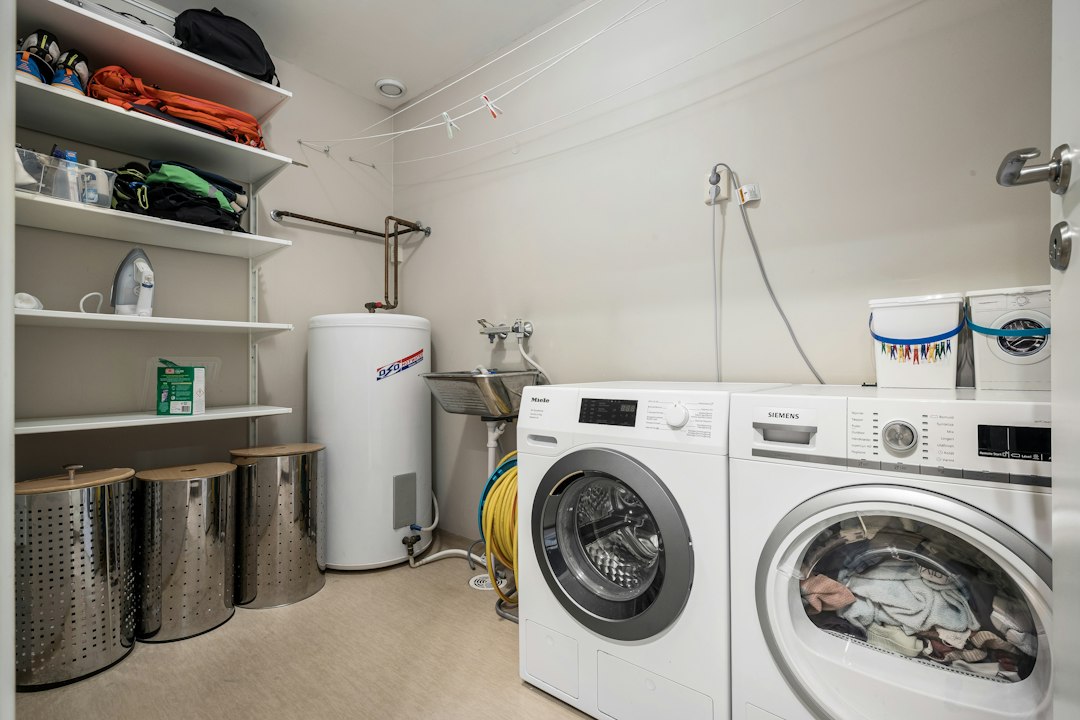
The average American household runs roughly 300 loads of laundry every single year. That translates to countless lost hours sorting fabric, re-washing loads you forgot were sitting damp in the drum, and running energy-hungry dryers during peak utility pricing hours. For a chore that occupies so much of our weekly bandwidth, the laundry area remains one of the most neglected utility zones in the modern house.
You do not need a five-figure renovation to fix this. By making strategic upgrades, introducing targeted automations, and rethinking your layout, you can build a smart laundry room that dramatically reduces physical labor and slashes your utility bills. Whether you are outfitting an expansive mudroom or optimizing a compact closet, here is how to turn your laundry hub into an efficient, low-friction powerhouse.
1. Upgrade Your Washing and Drying Hardware (Smartly)
The centerpiece of any laundry upgrade is the washer-dryer pair. Modern connected appliances do much more than send a notification when a cycle ends—they fundamentally change how resources are consumed.
Connected Machines vs. Retrofit Options
If you are in the market for new appliances, look for models featuring auto-dosing detergent reservoirs, integrated moisture sensors, and remote cycle scheduling. Auto-dosing systems calculate the exact volume of liquid detergent required based on weight and soil level, preventing over-sudsing (which forces your machine to run extra rinse cycles and waste gallons of water).
According to the U.S. Department of Energy, water heating accounts for about 90% of the energy your clothes washer uses, meaning optimized wash cycles and cold-water cleaning algorithms yield immediate financial savings.
Don't want to replace working machines? You can still build a smart laundry room on a budget:
- Vibration Sensors: Attach a Zigbee or Z-Wave multi-sensor to your legacy washer or dryer. When the vibration stops for more than three minutes, your smart hub triggers an alert to empty the machine.
- Heavy-Duty Smart Energy Monitors: Plug your washer into an energy-monitoring smart plug (ensure it meets amperage requirements) to track wattage drops that signal cycle completion.
Key Takeaway: Retrofitting existing machines with inexpensive vibration or power-draw sensors provides 80% of the functionality of a brand-new $1,500 smart washer for under $30.
2. Automate Environmental Controls and Safety
Laundry rooms generate heat, moisture, and lint—a potent combination that risks mold growth, structural dampness, and even house fires. Automating environmental safeguards protects your home while keeping ambient conditions optimal.
Smart Leak Detection with Auto-Shutoff
Washing machine supply hose bursts are among the leading causes of residential water damage. Place wireless water leak sensors on the floor directly behind and underneath your washing machine. For full protection, pair these sensors with a smart main water shutoff valve. If a hose leaks while you are away, the sensor tells the valve to cut the main water line within seconds, preventing catastrophic damage.
Automated Humidity and Airflow Management
Damp clothes and dryer exhaust spikes humidity. If your laundry room regularly exceeds 55% relative humidity, you invite mildew into wall cavities. Install a smart humidity-sensing switch tied to your exhaust fan. When the sensor detects a moisture surge, it kicks the exhaust fan on until relative humidity returns to baseline, pairing perfectly with your broader home energy audit checklist.
Safety-First Dryer Vent Monitoring
Lint buildup inside exhaust ducts forces your dryer to work harder, extending drying times and spiking energy use. Add a smart airflow sensor or magnetic temperature probe to the exterior vent pipe. If backpressure increases or exhaust temperatures rise abnormally, your system flags a blocked duct before it becomes a hazard.
3. Design an Ergonomic, Friction-Free Workflow
Smart tech falls flat if your physical layout forces unnecessary lifting, bending, and searching. Streamlining your spatial layout reduces the friction that leads to pileups.
Zone-Based Organization
Divide your space into four distinct functional zones, even within a single closet:
- Sorting Zone: Triple-compartment hampers (Lights, Darks, Linens) labeled clearly so family members pre-sort before you ever touch the garments.
- Staging & Prep: A slim magnetic shelf on the side of the washer holding stain-treatment rollers, garment brushes, and mesh wash bags.
- Transfer & Dry: Retractable wall-mounted drying racks positioned above or adjacent to the appliances to air-dry delicates without taking up floor space.
- Folding & Exit: A counter-height surface (such as a waterfall wood topper over front-loading machines) for immediate folding straight out of the drum.
If clutter has taken over your cabinets, use our practical blueprint for decluttering utility spaces to clear redundant bottles and tools before organizing your gear.
4. High-Impact Automations You Can Set Up Today
Once your hardware and sensors are in place, link them together. The goal is to eliminate mental overhead: you should never have to wonder if a load is done or if you left wet towels inside.
The "Never-Sour" Reminder Routine
We have all forgotten a wet load in the washer overnight, resulting in that dreaded sour odor. With a smart laundry room routine:
- Trigger: Washer power drops below 2W (cycle finished).
- Action 1: Broadcast announcement across smart speakers: "The washer has finished."
- Action 2: Change laundry room smart bulb color to blue.
- Action 3 (If door remains closed after 45 minutes): Send high-priority push notification to your phone: "Reminder: Move damp clothes to the dryer."
Off-Peak Scheduled Washing
If your power provider uses time-of-use (TOU) rates, electricity is significantly cheaper late at night or early in the morning. Load your machine after dinner, insert detergent, and use your appliance app or smart switch to delay the start until your utility's lowest-cost window kicks in. Implementing simple smart home automation routines like this can trim up to 15% off appliance operating costs over a year.
Motion-Activated Task Lighting
Hands are usually full when entering a utility closet or basement. Install an under-cabinet LED light strip wired to an inexpensive PIR motion sensor. As soon as you step into the room carrying a basket, bright 4000K neutral-white task lighting turns on instantly, switching off after two minutes of inactivity.
Key Takeaway: High-leverage automations don't just alert you when a task finishes—they build fail-safes that prevent double-washing, save energy during peak hours, and keep your hands free.
Your Action Step for Today
You don't need to rebuild your entire laundry setup this weekend. Start with a single high-impact fix: Install a smart leak sensor directly under your washing machine's water valve connections.
It takes less than five minutes to pair to your phone and place on the floor, providing instant protection against costly water damage while serving as the foundational building block for your new smart laundry room.

Written by
Nibedita Basu
English graduate and social worker with a passion for creating a warm, happy, and meaningful life. I write about Home, Food, and Pets — sharing practical ideas, everyday inspiration, and simple joys that make life more comfortable, wholesome, and fulfilling.